
What Causes Autism? Genetics, Environmental Factors, and Common Myths
When a child is diagnosed with autism, one of the first questions parents ask is “why?” Many also quietly wonder whether they did something to cause it. The short answer is no. Autism develops through a complex mix of factors, most of which are present before birth, and none of which is a parent’s fault.
Genetics play the largest part
Estimates from twin and family studies vary between about 60 and 90 percent; the bar shows the middle of that range.
Studies of twins and families show that autism is strongly heritable. Estimates suggest that genetic factors explain roughly 60 to 90 percent of the differences in who becomes autistic. This does not mean there is a single “autism gene.” Researchers have identified hundreds of genes that each add a small amount to the likelihood of autism, and a smaller number of gene changes that have a larger effect.
Some of these genetic changes are inherited from parents who may have no diagnosis at all. Others are new changes that arise for the first time in the child. This is why autism can appear in a family with no known history of it.
Factors around pregnancy and birth
Research has linked some prenatal and birth factors with a higher likelihood of autism. These include:
- Older parents, particularly an older father
- Being born very early or with a very low birth weight
- Some health conditions during pregnancy, such as diabetes or a serious infection with fever
- Exposure in the womb to certain medicines, most clearly the epilepsy medicine valproate
These factors increase the likelihood only slightly for most families. The great majority of children exposed to them are not autistic, and many autistic children had none of them.
Association is not the same as cause
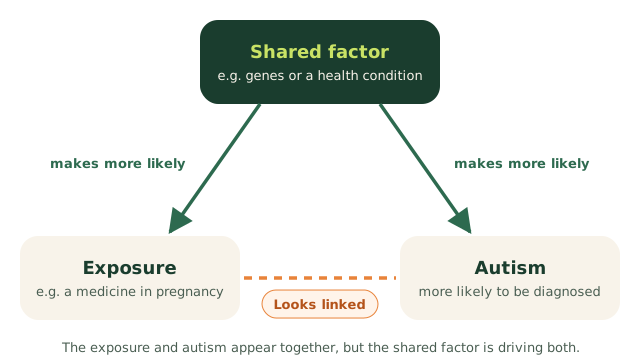
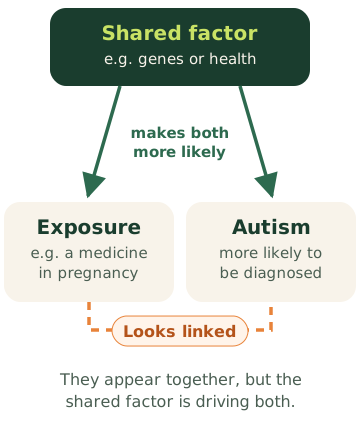
Headlines often report that something is “linked to” autism. A link, or association, means two things tend to appear together. It does not prove that one causes the other. Often a third factor, such as shared genes or a health condition, explains both.
Paracetamol (acetaminophen) in pregnancy is a good example. Some earlier studies found an association with autism. But when a large Swedish study of nearly 2.5 million children compared brothers and sisters from the same family, so that shared genes and home life were taken into account, the link disappeared. If you are pregnant, talk to your doctor before stopping any medicine you need, as a high fever that is left untreated carries its own risks.
What remains uncertain
Scientists still do not fully understand how different genes and early-life factors combine, or why autism looks so different from one person to the next. Research is also exploring areas such as the immune system and the gut microbiome. These are active questions, and you should be cautious of anyone who claims to have found “the cause” or a cure.
Common myths and concerns
- A common concern: “my child changed after their vaccines.” Many parents first notice signs of autism between 12 and 18 months, the same age children get several routine vaccines, so the timing can feel like more than coincidence. What you saw is real, and any change in your child deserves a doctor’s attention. Large studies following millions of children, including a Danish study of more than 650,000 children, have found autism is just as common in children who were not vaccinated, which tells us vaccines are not the cause.
- Myth: poor parenting causes autism. The old idea of cold “refrigerator mothers” was proven wrong decades ago. Parenting does not cause autism.
- Myth: screens or diet cause autism. There is no good evidence that screen time, gluten, sugar or any food causes autism.
- Myth: there is an autism epidemic. Diagnoses have risen mainly because the definition has broadened and awareness and screening have improved, so more people, including girls and adults, are recognised.
A quick test for any headline
Ask: did the study compare like with like, for example brothers and sisters from the same family? Did the link survive once shared genes and health were taken into account? If not, it shows an association, not a cause.
Why the cause matters less than support
Understanding causes helps research and can sometimes guide medical care, for example when a specific genetic condition is found. But for most families, the most useful questions are practical ones: what does my child need, and what support will help them thrive?
How FXMed can help
While we cannot change what causes autism, we can help you understand and address health issues that affect how your child feels day to day. Our Autism Support program works alongside your child’s paediatrician, therapists and school. It does not aim to cure or change autism. It focuses on the physical health issues, such as digestion, nutrition and sleep, that can make everyday life harder.
This article is for general education and does not replace advice from your own doctor or care team. If you are worried about your child’s development or health, please speak to a qualified professional.
About the Author
FXMed Team
Related Articles
Understanding Autism: What the Spectrum Really Means
Autism is called a spectrum because no two autistic people are the same. Here is what that really me...
Early Signs of Autism in Babies and Toddlers: When to Seek Support
Signs of autism can often be seen in the first two years. Learn what to look for in communication, p...