
Understanding Autism: What the Spectrum Really Means
You may have heard the phrase “if you’ve met one autistic person, you’ve met one autistic person.” It is a good place to start. Autism is called a spectrum not because people sit somewhere between “a little” and “a lot” autistic, but because autism shows up in many different ways, and each person has their own mix of strengths, challenges and needs.
What is autism?
Autism is a lifelong developmental difference in how a person’s brain processes information, communicates and experiences the world. Doctors look at two broad areas when making a diagnosis:
- Social communication and interaction. Differences in using and reading eye contact, facial expressions, gestures and tone of voice, in back-and-forth conversation, and in making and keeping friendships.
- Repetitive behaviours, focused interests and sensory differences. This can include repeated movements or phrases, a strong preference for routine, deep interests in particular topics, and being over- or under-sensitive to sound, light, touch, taste or smell.
These traits appear in early childhood, although they are sometimes not recognised until much later, when life demands more than a person can manage without support.
Communication comes in many forms
All of these are communication
Some autistic people talk early and fluently; others use few or no spoken words. Many fall somewhere in between, or find that their ability to speak changes with stress and tiredness. Communication can include speech, gestures, pictures, writing, sign language and communication devices. All of these are real communication and deserve to be respected.
Autistic people may also communicate more directly, take words literally or find small talk tiring. These are differences, not failures. Many autistic people say they communicate easily with other autistic people. The difficulty often lies in the gap between two styles.
Sensory experiences
For many autistic people, the senses work differently. A ticking clock might feel unbearable; the label in a shirt might feel like sandpaper; a crowded market might be overwhelming. Others seek out sensations, such as spinning, deep pressure or strong flavours. Understanding a person’s sensory profile often explains behaviour that looks puzzling from the outside, and small changes like ear defenders or softer clothing can make a big difference.
Strengths matter too
Common strengths
Autism is not only a list of challenges. Many autistic people have strengths such as attention to detail, deep knowledge of their interests, honesty, strong memory, pattern spotting and loyalty. Building on these strengths, rather than only working on weaknesses, helps children grow in confidence.
Support needs differ, and change over time
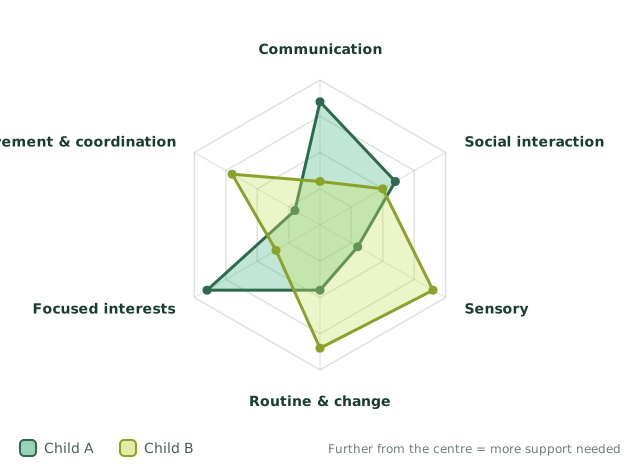
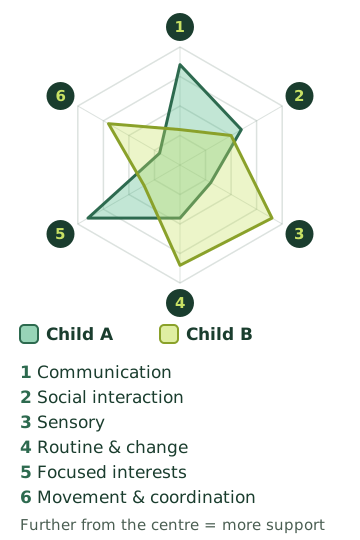
Some autistic people need help with most daily activities. Others live independently but still need understanding at school or work. Clinicians sometimes describe three “levels” of support need, but a single level never tells the whole story. A child may be very capable in one area and need a lot of help in another, and needs often change with age, stress and environment.
Autism also often comes with other conditions, which can affect quality of life as much as autism itself. These include:
- ADHD, anxiety and sleep difficulties
- Digestive problems such as constipation and tummy pain
- Epilepsy, which is more common in autistic people than in the general population
- Intellectual disability in some people, though many autistic people have average or above-average intelligence
Words and labels
You will see both “autistic person” and “person with autism.” Many autistic adults prefer “autistic person” because they see autism as part of who they are. Some families prefer the other. The kindest approach is to ask, and to follow the person’s own preference.
Key takeaways
At a glance
- Autism is a lifelong difference in communication, interaction and sensory processing, not an illness.
- The spectrum describes variety, not a scale from mild to severe.
- Every autistic person has a unique mix of strengths and support needs.
- Co-occurring health conditions are common and worth looking for.
How FXMed can help
Many autistic children also live with physical health problems that can go unnoticed, especially when a child finds it hard to say what hurts. Our Autism Support program works alongside your child’s paediatrician, therapists and school. It does not aim to cure or change autism. It focuses on the physical health issues, such as digestion, nutrition and sleep, that can make everyday life harder.
This article is for general education and does not replace advice from your own doctor or care team. If you are worried about your child’s development or health, please speak to a qualified professional.
About the Author
FXMed Team
Related Articles
What Causes Autism? Genetics, Environmental Factors, and Common Myths
What does research actually show about the causes of autism? We explain the role of genetics, prenat...
Early Signs of Autism in Babies and Toddlers: When to Seek Support
Signs of autism can often be seen in the first two years. Learn what to look for in communication, p...