
Speech Delay or Autism? Understanding Communication Differences
“He’s not talking yet. Is it autism?” It is one of the most common questions parents ask. Speech delay and autism can look similar at first, and they sometimes occur together. But a speech delay on its own does not mean a child is autistic. Understanding the difference helps you get the right support sooner.
What is a speech delay?
A child has a speech or language delay when they are developing words and sentences more slowly than expected for their age. Some children, often called “late talkers”, catch up by themselves by around age 3. Others need speech and language therapy. Speech delay can stand alone or be part of a wider picture, such as hearing loss, a language disorder or autism.
Where speech delay and autism overlap
Many autistic children start talking late, and some use few or no spoken words. Both groups may:
- Say fewer words than other children their age
- Get frustrated when they cannot make themselves understood
- Find it hard to follow longer instructions
Differences that can help tell them apart
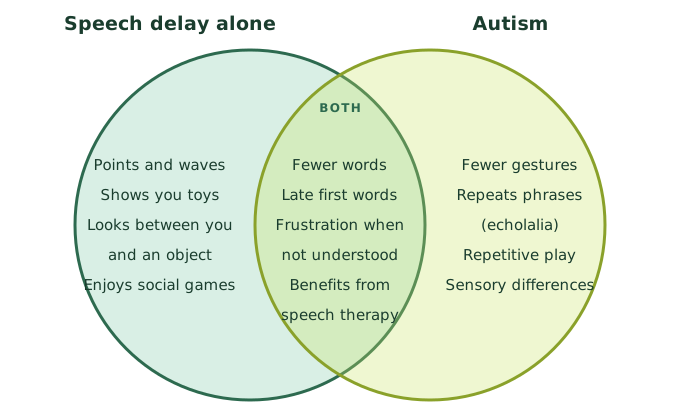
The biggest clue is usually social communication, meaning the drive and ability to connect and share with others, with or without words.
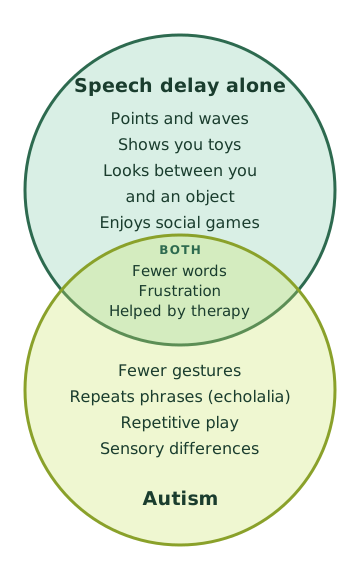
- Children with a speech delay alone usually make up for missing words in other ways. They point to show you things, use gestures like waving and nodding, look back and forth between you and an object, bring you toys to share, and enjoy social games.
- Autistic children more often use fewer gestures and less eye contact, rarely point to share interest, may lead you by the hand to what they want, and may not respond to their name. They may also repeat words or whole phrases from songs or shows (echolalia), and show repetitive behaviours or strong sensory reactions.
These are general patterns, not rules. Some autistic children are very affectionate and social, and some children with language disorders have social difficulties too. That is why a professional assessment matters.
Always check hearing first
Before anything else: a hearing test
A child who reacts to some sounds can still have hearing loss. Fluid in the middle ear after repeated infections can muffle sound for months.
Hearing problems are a common and treatable cause of speech delay. Fluid in the middle ear (glue ear) after repeated ear infections can muffle sound for months. Any child with delayed speech, or who does not respond to their name, should have a proper hearing test. A child who reacts to some sounds can still have hearing loss.
Growing up with more than one language
Many children in Nigeria hear two or more languages at home. This is a strength, not a cause of delay. Bilingual children may mix languages or know some words in only one language, but their total vocabulary across languages should be on track. If a bilingual child is behind in all their languages, they should be assessed like any other child.
Who can help
- Your paediatrician can review development, screen for autism and arrange a hearing test.
- A speech and language therapist can assess your child’s understanding, use of language and communication and start therapy.
- A developmental paediatrician or psychologist can carry out a full developmental or autism assessment if needed.
Do not wait and see
If your child is not using single words by around 16 months or two-word phrases by 24 months, or if they lose words they once used, ask for an assessment. Speech therapy can start right away and helps children whether or not they turn out to be autistic.
What you can do at home
Narrate
Talk about what your child is looking at or doing in short phrases.
Wait
Give time to respond, and celebrate every attempt, including gestures.
Read daily
Point to and name pictures together.
Turn it down
Switch off background TV during play and meals.
How FXMed can help
If your child is autistic, we can support the physical side of their health, such as digestion, sleep and nutrition, which affects comfort, mood and readiness to learn. Our Autism Support program works alongside your child’s paediatrician, therapists and school. It does not aim to cure or change autism. It focuses on the physical health issues, such as digestion, nutrition and sleep, that can make everyday life harder.
This article is for general education and does not replace advice from your own doctor or care team. If you are worried about your child’s development or health, please speak to a qualified professional.
About the Author
FXMed Team
Related Articles
Understanding Autism: What the Spectrum Really Means
Autism is called a spectrum because no two autistic people are the same. Here is what that really me...
What Causes Autism? Genetics, Environmental Factors, and Common Myths
What does research actually show about the causes of autism? We explain the role of genetics, prenat...